Divide whole numbers in cases where there is a remainder. Transition from using area models and number bonds to the partial quotients algorithm. Develop fluency with procedures in order to focus on understanding and interpreting the meaning of the remainder. This work lays the foundation for understanding fractions and decimals.
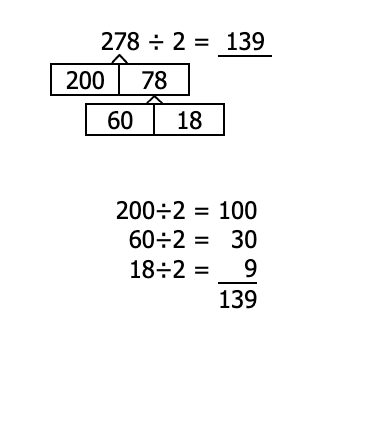
Transition from area models to number bonds. Divide by breaking the total into smaller, known multiples that are easier to divide. What's 278÷2? Think of 278 as 200+60+18, or 2 hundreds, 6 tens, and 18 ones. 278÷2 = (200÷2) + (60÷2) + (18÷2) = 100+30+9 = 139. Find and add partial quotients to get the total quotient. Prerequisites: 4-47 ○ 4-13
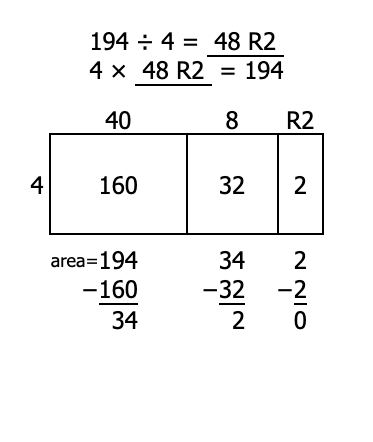
Divide numbers that are not multiples of the divisor. What's 194÷4? Draw a rectangle with area 194 and short side 4. Break the total area recursively into partial areas that are multiples of 4 and what's left. Since 194 = 160+32+2 and 2 is less than the divisor, it's the remainder. 194÷4 = (160÷4) + (32÷4) + (2÷4) = 48 R2. Prerequisites: 4-47
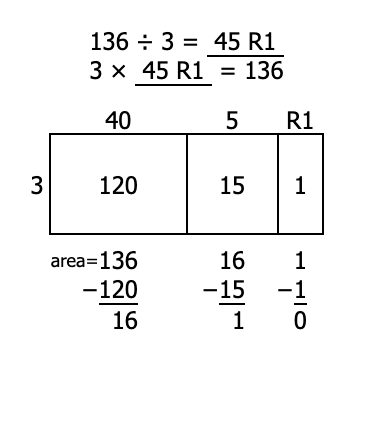
Transition from dividing concretely with area models to dividing pictorially with number bonds. What's 136÷3? Divide the total recursively into known multiples of 3 and what's left. Since 136 = 120+15+1, 136÷3 = (120÷3) + (15÷3) + (1÷3) = 45 R1. Any part smaller than the divisor is called the remainder. Prerequisites: 4-48