Divide when the quotient is a fraction, using bar models to build understanding. Use the breaking into 1s strategy and the partial quotients strategy. Divide unit fractions into equal groups, using the sharing model, to understand the conventional invert-and-multiply algorithm.
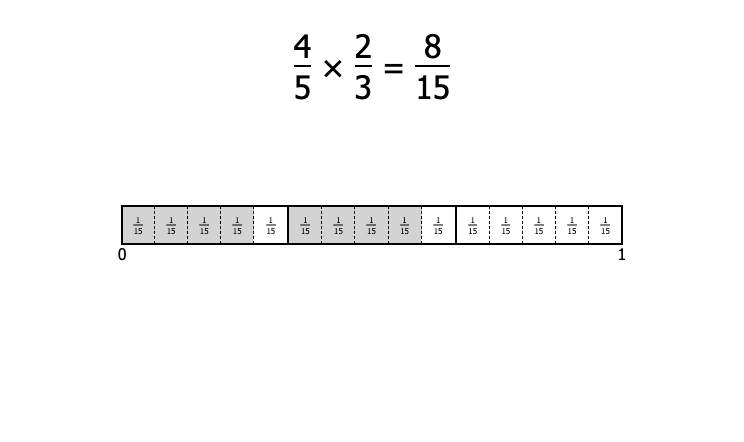
Multiply proper fractions by breaking one or both proper fractions into unit fractions. What's 4/5 x 2/3? Since 2/3 = 1/3 + 1/3, multiply 4/5 x (1/3 + 1/3) = 4/15 + 4/15 = 8/15. Algorithm? Multiply numerators to get the number of new parts. Multiply denominators to get the size of each part. What's 2/3 x 2/3? (2x2)/(3x3) = 4/9. Prerequisites: 5-55
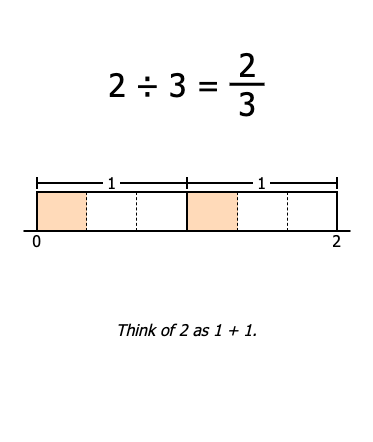
Divide whole numbers that aren't multiples of the divisor. Break the total into ones and apply the distributive property. What's 2÷3? Since 2 = 1+1, 2÷3 = (1+1)÷3 = (1÷3)+(1÷3) = 1/3 + 1/3 = 2/3. What's 3÷5? It's (1+1+1)÷5 = 1/5 + 1/5 + 1/5 = 3/5. Find and add partial quotients to get the total quotient. Algorithm? x÷y = x/y. Prerequisites: 5-51
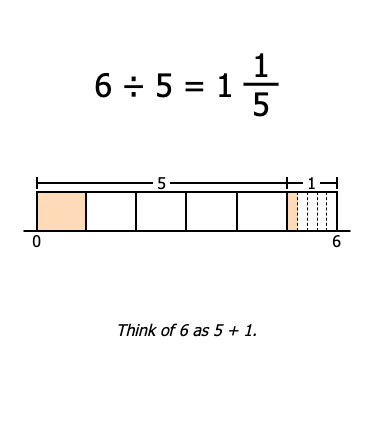
Instead of breaking the total into 1s, break the dividend into a multiple of the divisor and what's left. Find and add partial quotients to get the total quotient. What's 6÷5? Since 6 = 5+1, 6÷5 = (5+1)÷5 = (5÷5)+(1÷5) = 1 + 1/5 = 1 1/5. What's 8÷3? Since 8 = 6+2, 8÷3 = (6+2)÷3 = (6÷3)+(2÷3) = 2 + 2/3 = 2 2/3. Prerequisites: 5-67