Explore the inverse relationship between the number of fractional parts and each part’s size by seeing that a larger number in the denominator does not mean a larger piece. Students convert fractions to mixed numbers, mixed numbers to fractions, and prepare for fraction operations by making common denominators.
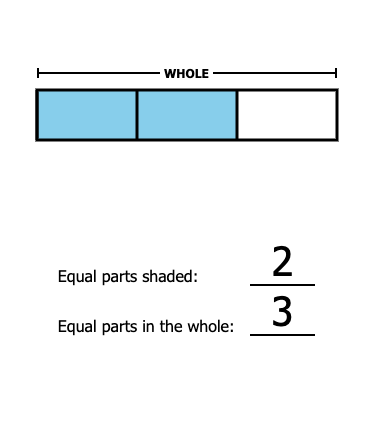
Use colored rods and draw bar models to represent proper fractions - fractions less than a whole. If the bar is divided into thirds - 1 third is a unit fraction, 2 thirds is a proper fraction, and 3 thirds is the whole. Since a unit is less than the whole, it is also a proper fraction. Prerequisites: 2-53
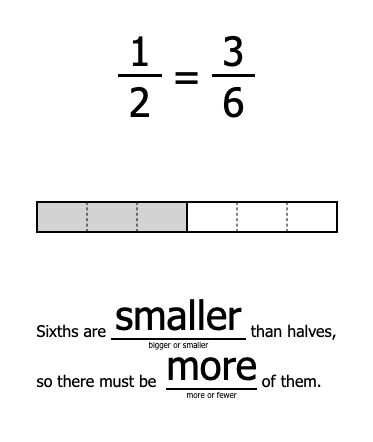
Draw bar models to find equivalent fractions on a number line. 1 half is how many sixths? Divide the distance between 0 and 1 into 2 equal parts. Shade 1 part, or 1/2. To make sixths, partition each half into 3 equal parts. Since there are now 6 equal parts in 1, each part is 1 sixth, or 1/6. 3 sixths are shaded, so 1/2 = 3/6. Prerequisites: 3-83
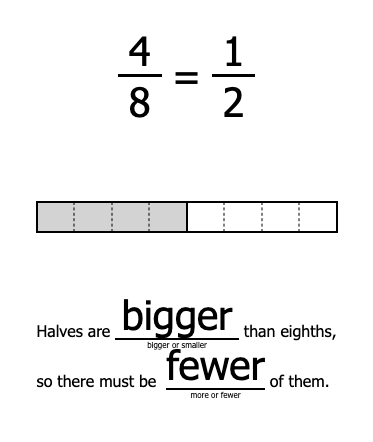
Generalize from finding more parts, to finding more challenging, equivalent fractions with fewer parts. 4 eighths is how many halves? Divide 1 – the distance between 0 and 1 – into 8 equal parts. Shade 4 parts, or 4/8. Think of the shaded 4/8 as 1 part. How many are in 1? Since there are 2, each is 1 half, and 4/8 = 1/2. Prerequisites: 3-84