Draw equal-group models in contexts that have remainders, and decide the meaning of the remainder. For example, if we are finding the number of people that fit in a car, a remainder of 2 may mean that we need another car. Use bar models to visualize equal groups word problems when one or both numbers are fractions.
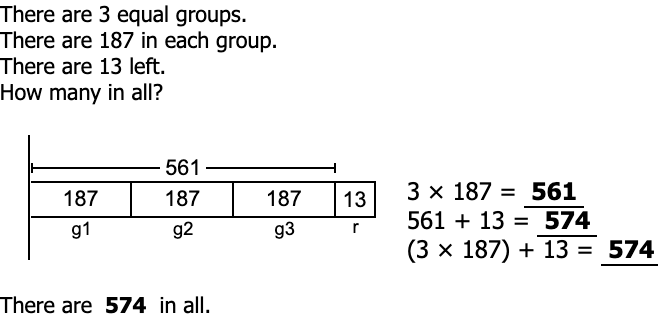
Interpret the remainder when the total is unknown. If there are 3 groups with 187 in each group, plus 13 more, how many in all? Multiply 3x187 = 561. Add 13 to get a total of 561+13 = 574. To solve as a single equation, use parentheses to group numbers explicitly. Follow the correct order of operations to get (3x187)+13 = 574. Prerequisites: 4-68 ○ 4-55
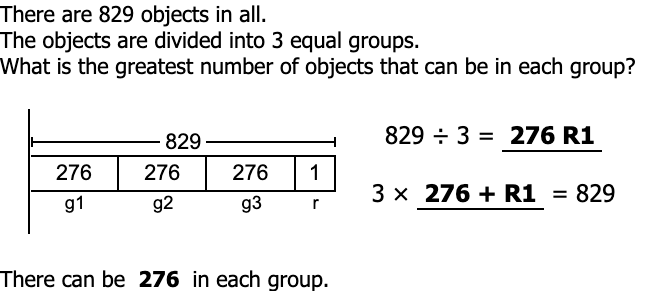
Interpret the remainder when dividing to find the size of each group. If 829 is divided into 3 equal groups, what's the most that can be in each group? 829 = 600+210+18+1, so 829÷3 = (6 hundreds÷3) + (21 tens÷3) + (18 ones÷3) + (1 one÷3) = 276 R1. The most that can be in each group is 276, so the remainder is ignored. Prerequisites: 4-69
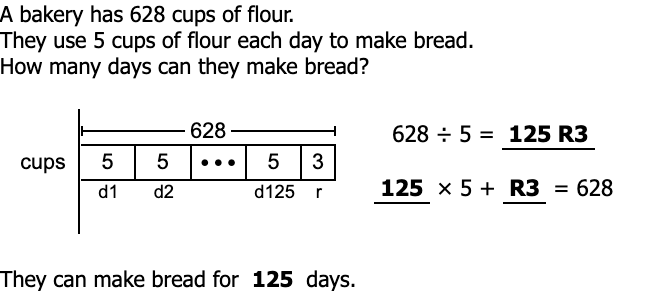
Interpret the remainder when using division to find the number of equal groups. Depending on the context, the remainder can either be ignored or can mean the number of groups is 1 more than what was calculated. Prerequisites: 4-70