Convert length, mass (weight), liquid volume, or time from smaller-sized units to an equivalent using larger-sized units. Use bar models to represent the relationship between smaller and larger-sized units of measurement. Derive unit rates and commit to memory common conversion rates.
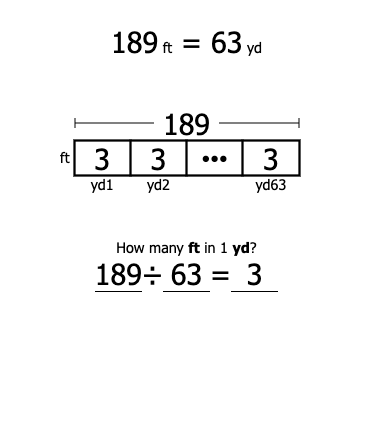
Derive unit rates – the number of smaller units in 1 larger unit – for units of length, weight, and liquid volume. If 189 feet = 63 yards, how many feet is 1 yard? Draw a bar model to visualize the relationship between feet and yards. 189 ÷ 63 = 3, so 3 feet = 1 yard. Thinking proportionally, 189 ft = 63 yd, 21 ft = 7 yd, 3 ft = 1 yd. Prerequisites: 4-52 ○ 5-27, 4-16
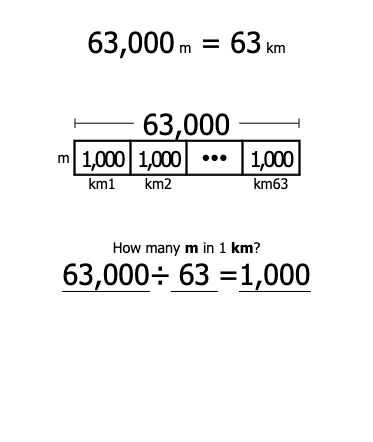
Derive unit rates for length, mass (weight), and liquid volume. Use prefixes (kilo=thousand, milli=thousandth, centi=hundredth) to make unit rates easier to remember. If 63,000 m = 63 km, how many meters is 1 kilometer? Use a bar model to see 1,000 m = 1 km. 63,000 m = 63 km, so 7,000 m = 7 km and 1,000 m = 1 km. Prerequisites: 5-118 ○ 4-46
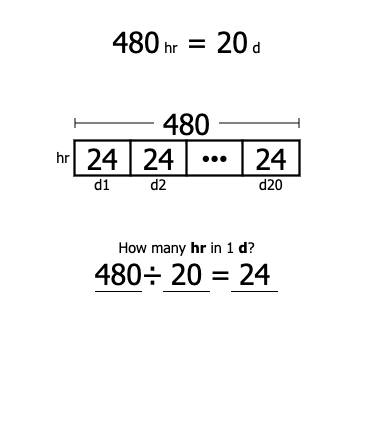
Derive unit rates for clock and calendar time. If 480 hours = 20 days, how many hours is 1 day? Draw a bar model to see 24 hr = 1 d. Thinking proportionally, 480 hr = 20 d, so 240 hr = 10 d, and 24 hr = 1 d. Learn and memorize – commit to memory – common conversion rates for units of time. Prerequisites: 5-118 ○ 5-27