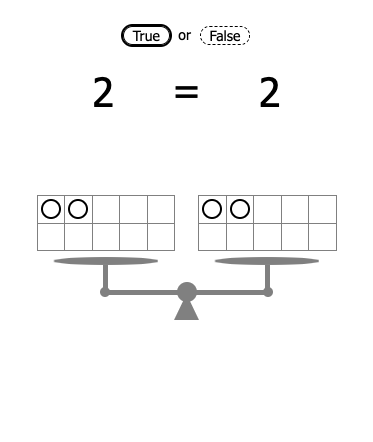
Balance equations to build the understanding that the equal sign means "has the same value as" and not, "the answer is." Evaluate equations and create true equations when a number is missing, using addition and subtraction within 20.
Reinforce the meaning of “equal” and the equal sign by comparing the value of one side of an equation with the value of the other side. Do both sides have the same value? If so, both sides are equal and the equation is "true." If both sides are not equal, the equation is "false" and the "equation" is not really an equation. Prerequisites: K-26
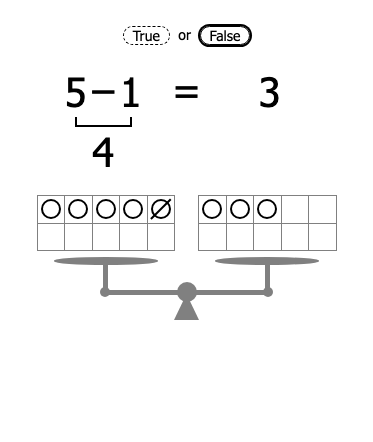
Develop fluency and reinforce the meaning of the equal sign. Enrich by comparing the value of a subtraction expression to a number. Is the value of the expression 5-1 equal to 3? Since 5-1 = 4, 5-1 is not equal to 3. The "equation" is false and is not an equation. For enrichment, compare expressions on both sides of the equal sign. Prerequisites: K-42 ○ K-35
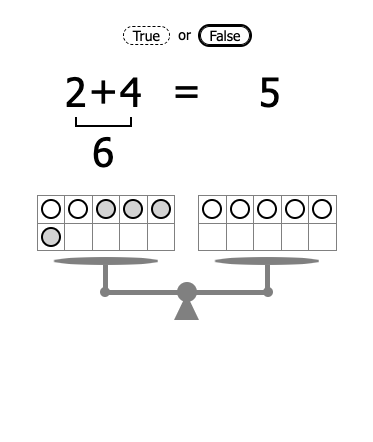
Develop fluency while reinforcing the meaning of "equal." Enrich by comparing an addition expression to a number. Are their values the same? If so, the equation is true. If not, the "equation" is false. In an equation, both sides of the equal sign must have the same value. When ready, compare 2 expressions in 1 equation. Prerequisites: K-83 ○ K-80, K-45