Use number lines, number bonds, and shifting 60 when necessary, to solve problems where a start time, end time, or elapsed time is unknown. Understand that the whole unit in time, is 60 minutes, not 100, as in our base 10 system, and that the numbers on a clock face have 2 meanings -- 6 means 6:00 and 30 minutes after the hour. Use benchmark numbers, on an open number line, to make small jumps to calculate elapsed time.
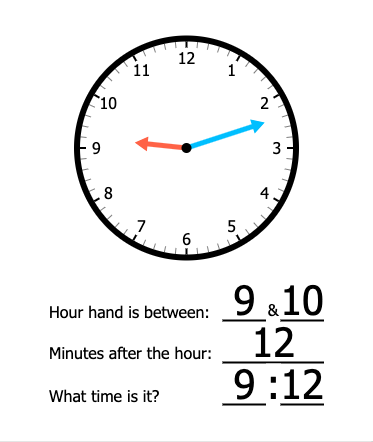
Start by reading time on an analog clock to the nearest 1 minute. What time is it when the hour hand is between 9 and 10 and the minute hand shows 12 minutes after the hour? 9 hours and 12 minutes have elapsed since 12:00, so it's "nine twelve" or "12 minutes after 9." Progress to drawing hour and minute hands. Prerequisites: 2-126
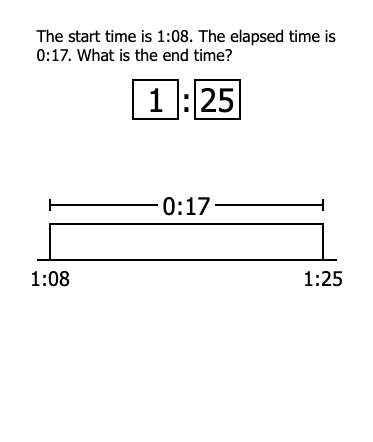
Use a timeline to solve elapsed time problems by visualizing the start time, elapsed time, and end time. Start by finding the end time – result unknown problems – when the end time and start time are within the same hour. If the start time is 1:08 and elapsed time is :17, what is the end time? It's 1:08 + :17 = 1:25. Prerequisites: 3-125 ○ 2-40, 2-36
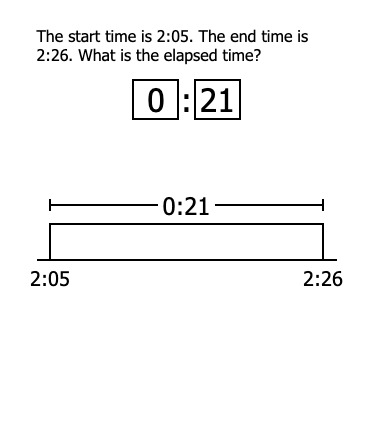
Find the elapsed time – change unknown problems – when the end time and start time are within the same hour. If the start time is 2:05 and the end time is 2:26, what is the elapsed time? Solve 2:05 + ? = 2:26, or 2:26 - ? = 2:05. Add or subtract in 1 or more steps to find the difference. The elapsed time is :21. Prerequisites: 3-126 ○ 2-41, 2-37