Identify when fractional parts are equal in size and together make the whole. Learn the names of halfs, thirds, and fourths, to describe when the whole has 2, 3, or 4 equal parts. Work with fractional parts that are the same size, but not the same shape, and begin to use fraction notation. Learn the meaning of the words numerator and denominator.
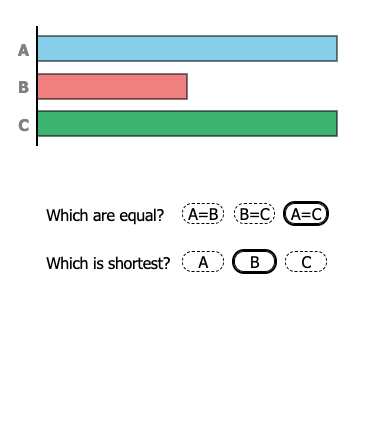
To prepare for fractions, apply the concept of "equal" to length. Use the equal symbol (=) to mean "has the same length as." "B = C" means "B has the same length as C." Given 3 colored bars – A, B, and C – which 2 bars are the same length? Which bar is the longest? Which bar is the shortest? Prerequisites: K-71 ○ K-88
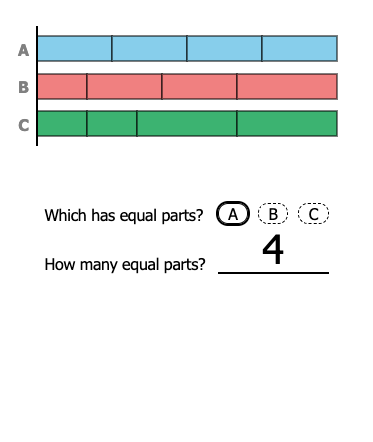
Introduce fractional parts that are equal in size and together make the whole. Use length models – colored rods, strips of paper, drawn bars – to model part-whole relationships. Which bar has equal parts? How many equal parts? What is the name of each part? Learn 2 halves, 3 thirds, and 4 fourths make the whole. Prerequisites: K-131
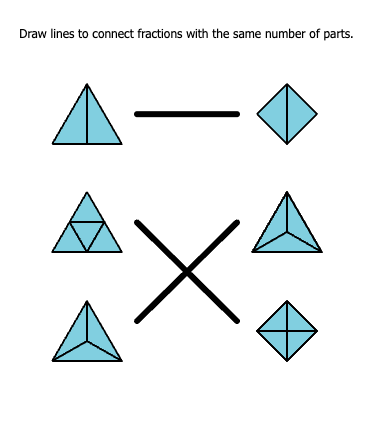
Generalize from squares and circles to identifying fractional parts of equilateral triangles and rotated squares. Which shapes have 2 equal parts? 3 equal parts? 4 equal parts? Match shapes that have the same number of equal parts. When ready, match shapes to the correct number and name of their equal parts. Prerequisites: K-133