Observe attributes of objects and reason about which categories an object fits, or does not fit. Classify and compare shapes by defining attributes and learn to identify lines of symmetry. Develop reasoning skills and fluency with 4-sided shapes by exploring the heirarchy of quadrilaterals.
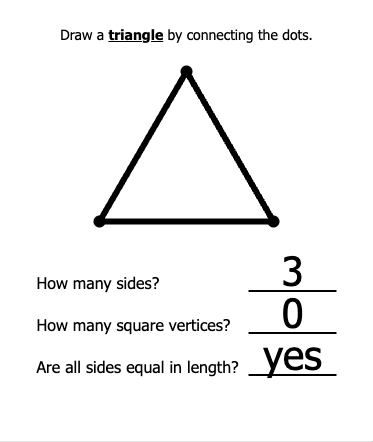
Explore the defining attributes – number of sides, equal sides, vertices, and square corners – that determine if a shape is a triangle, quadrilateral, rectangle, square, pentagon, or hexagon. In contrast, non-defining attributes – color, rotation, and size – describe a shape, but don't define or determine what kind of shape it is. Prerequisites: 1-134
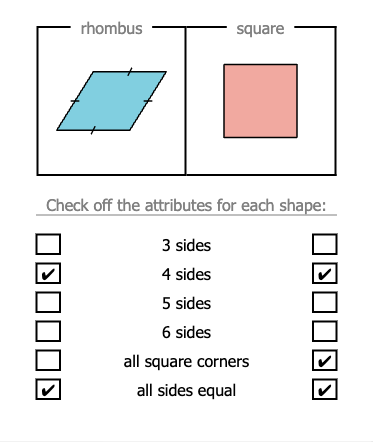
Categorize shapes by identifying their defining attributes. If a shape has 4 equal sides, 2 pairs of parallel sides, and 4 square corners, what kind of shape is it? Can a shape have more than one name or category? It's a quadrilateral, rhombus, rectangle, and square. Goal is to commit names and attributes to memory. Prerequisites: 2-134
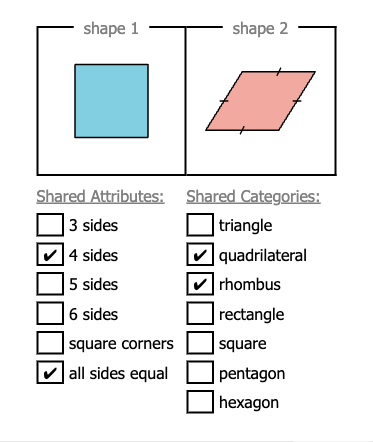
Explore how categories are related by identifying shared attributes. Which defining attributes do a square and rhombus have in common? They both have 4 equal sides, so both are quadrilaterals and rhombuses. Since squares also have 4 square corners, they're a special kind of rhombus and called a subcategory. Prerequisites: 3-134