Use knowledge of place value and fractions to represent fractions in the Base 10 number system, as decimals. Use base 10 blocks, base 10 discs and number bonds to model ones, tenths, and hundredths. Convert ones into tenths and ones into tenths and hundredths.
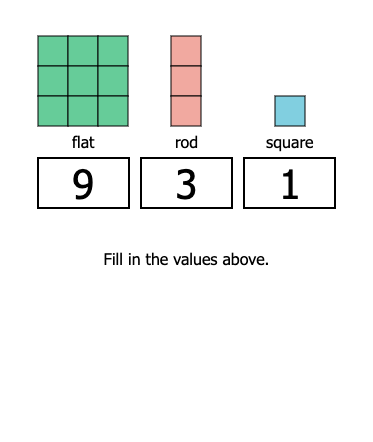
Prepare for modeling decimals by using concrete models in a flexible way. If a flat has 9 unit squares so its value is 9 instead of 100, what's the value of the rod? Here, a rod is a flat divided into 3 equal parts, so 1 rod = 9÷3 = 3. What's the value of the square? A square is a rod divided into 3 equal parts, so 1 square = 3÷3 = 1. Prerequisites: 3-22
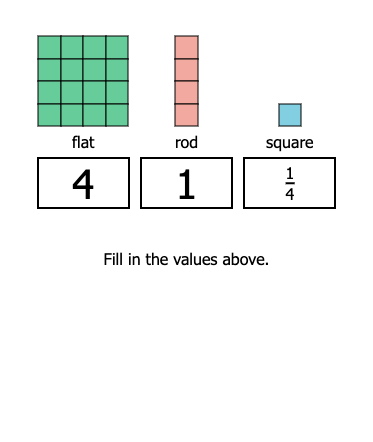
Transition from thinking proportionally about just whole numbers, to including fractions, too. If a flat has 16 squares and its total value is 4, what's the value of a rod? A rod is a flat divided into 4 equal parts, so 1 rod = 4÷4 = 1. What's the value of the square? A square is a rod divided into 4 equal parts, so 1 square = 1÷4 = 1/4. Prerequisites: 4-110
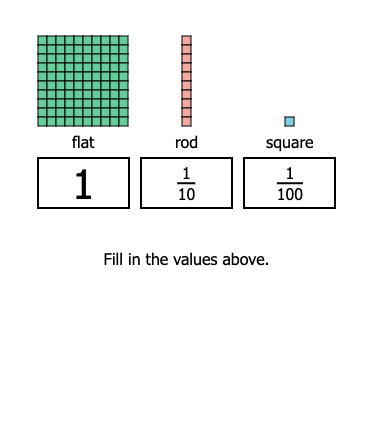
Focus on decimal fractions – tenths and hundredths. If a flat has 100 squares and a total value of 1, what is the value of 1 square? What's 1 divided into 100 equal parts? Each square is 1 hundredth, or 1/100. How many hundredths in a flat? 100, and 100 x 1/100 = 1. How many hundredths in a rod? 10, and 10 x 1/100 = 1/10. Prerequisites: 4-111 ○ 3-22