Add decimals by joining addends by place value. Rename tenths as hundredths or hundredths as thousandths, when necessary to find a sum. Start modeling with base 10 blocks, and move to modeling numbers with base 10 discs and then number bonds, laying the foundation for vertical algorithms.
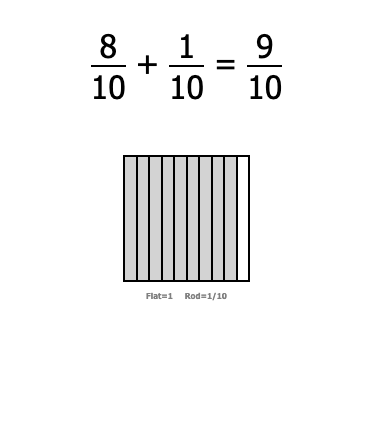
Use Base 10 blocks to add tenths and hundredths. What's 8/10 + 1/10? If a flat is 1, a rod is 1/10. 8 rods + 1 rod = 9 rods, so 8/10 + 1/10 = 9/10. What's 29/100 + 11/100? Since a square is 1/100, 29 squares + 11 squares = 40 squares, and 29/100 + 11/100 = 40/100. Add fractions by thinking in units of tenths and hundredths. Prerequisites: 4-98
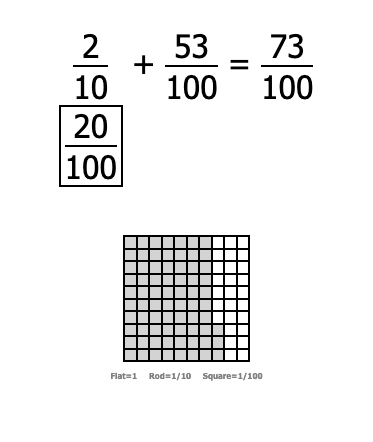
Use Base 10 blocks to rename and add tenths to hundredths. What's 2/10 + 53/100? The denominators are not the same, so make hundredths – a common unit. If a flat is 1, each vertical column or rod is 1/10, and each square is 1/100. Since 2/10 is 2 columns, 20 squares, and 20/100, 2/10 + 53/100 = 20/100 + 53/100 = 73/100. Prerequisites: 4-112 ○ 3-22
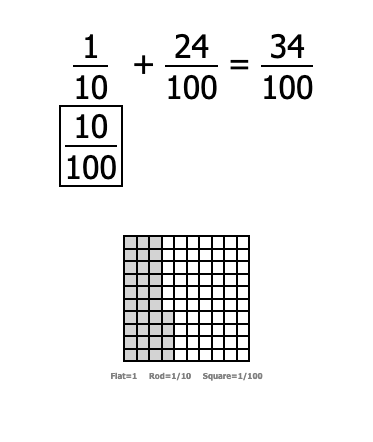
Add tenths and hundredths concretely using Base 10 blocks. What's a common unit? Hundredths. If a flat is 1, each rod or column is 1/10 = 10/100. What's 1/10 + 24/100? 1/10 is 1 rod or 10/100. 10/100 + 24/100 = 34/100. Use Base 10 blocks to visualize equivalent fractions and add hundredths. Prerequisites: 4-114