Solve comparison word problems by identifying the larger unknown, the smaller unknown, or the scale factor that relates both amounts multiplicatively. Use bar models, the standard multiplication algorithm, and division in 1-step solutions.
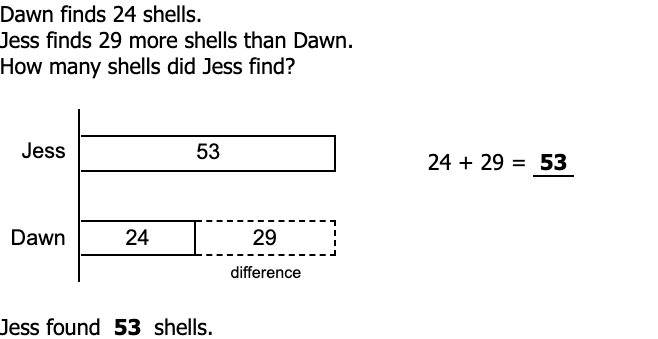
Assess understanding of additive comparison by solving problems where the keyword "more" or "fewer" is used to describe the difference. Include problems where the difference, larger number, or smaller number is unknown. Interpret and understand context to make sense of how keywords are being used. Prerequisites: 2-51, 2-50
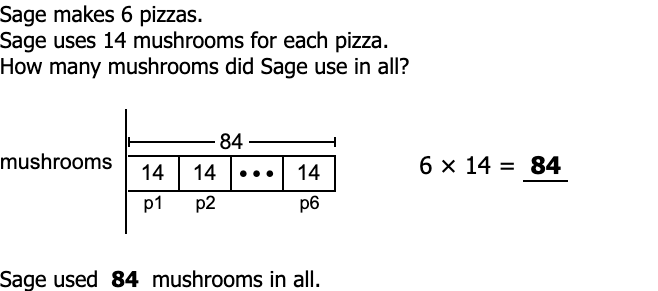
Model story problems to provide context for multiplication. Given the number of equal groups and size of each group, find the total. Use a bar model to represent the relationship between the parts and total. Apply the distributive property to find and add partial products to get the total product. Prerequisites: 3-108 ○ 3-47
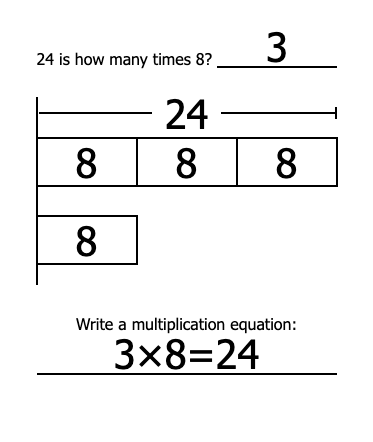
Introduce multiplicative comparison. How much greater is 24 than 8? Instead of thinking additively that 24 is 16 more than 8, think multiplicatively and find the scale factor – 24 is how many times 8. Draw a bar model or use multiplication facts to know 3x8 = 24, so 3 is the scale factor and 24 is 3 times as many as 8. Prerequisites: 4-9