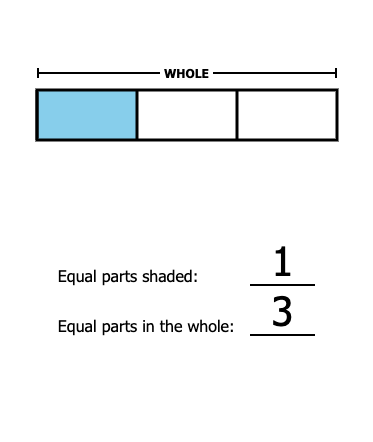
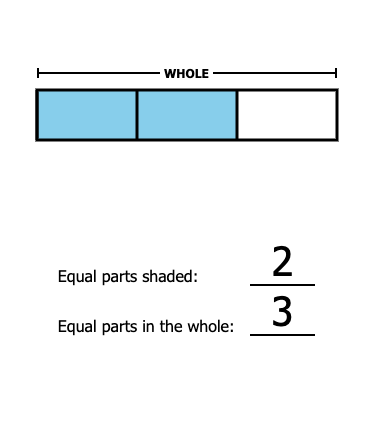
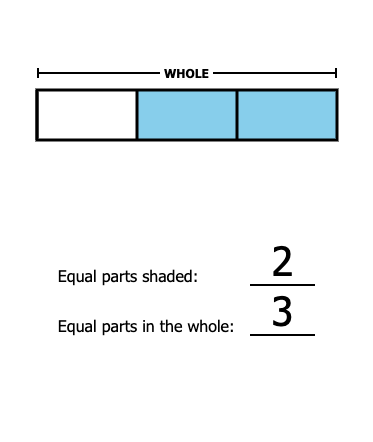
Extend fraction modeling skills to work with denominators of eighths and sixths. Model proper fractions flexibly, and know, for example, that any 2 of the parts can be colored in to show 2 thirds. Prove that fractional parts of different shapes are the same size by dividing them into smaller squares and confirming that they each have the same number of smaller parts.
Use linear bar models to model 1 half, 1 third, 1 fourth, and 1 eighth. Draw halves by dividing the whole – the length of a bar – into 2 equal parts. Make thirds by drawing 3 equal parts. Make fourths or quarters by dividing halves in half to make 4 equal parts. Make eighths by dividing fourths in half to make 8 equal parts. Prerequisites: 1-82
Use colored rods and draw bar models to represent proper fractions - fractions less than a whole. If the bar is divided into thirds - 1 third is a unit fraction, 2 thirds is a proper fraction, and 3 thirds is the whole. Since a unit is less than the whole, it is also a proper fraction. Prerequisites: 2-53
Generalize about equal parts by modeling fractions in different ways. What does 2 thirds mean? 2 out of 3 equal parts - any 2. The go-to way to show proper fractions using a bar model is left-to-right, with no gaps - a length model. Encourage flexibility by modeling them right-to-left, and with gaps - an area model. Prerequisites: 2-55