Compare the size of two fractions of a same-sized whole, to help develop number sense. Learn different strategies to compare fractions with equal numerators, equal denominators, and unambiguous cases where one fraction has more larger pieces, and the other has fewer, smaller pieces.
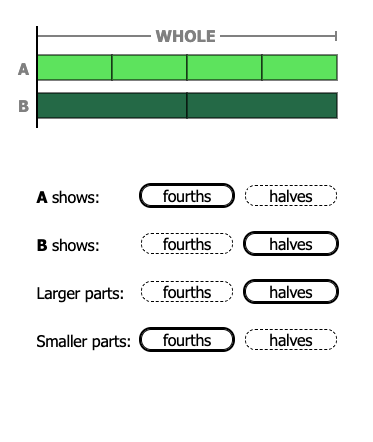
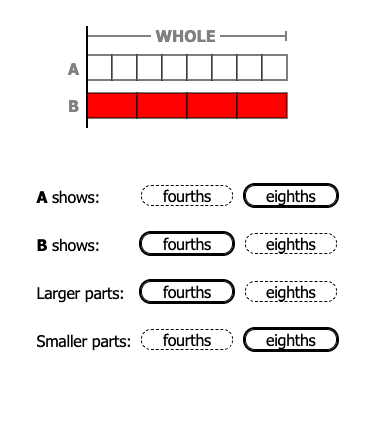
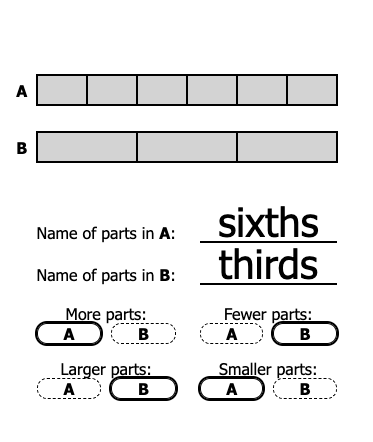
Compare the unit fractions 1 half, 1 third, and 1 fourth. When the whole is the same, more equal parts mean smaller parts. Fewer equal parts mean larger parts. There is an inverse relationship between the number of pieces and size of equal pieces. Length models – colored rods and bars – make comparing fractions, easier. Prerequisites: 1-82
Use colored rods and bar models to compare unit fractions. Explore the relationship between the number of equal parts and their size. For the same whole, more equal parts means smaller parts, and fewer equal parts means larger parts. There is an inverse relationship between the number of parts in the whole and their size. Prerequisites: 1-85 ○ 2-53
Use bar models to compare the size of unit fractions. On a number line, show larger denominators mean more equal parts so each part is smaller. Smaller denominators mean fewer equal parts so each part is larger. Large denominators have smaller parts. Small denominators have larger parts. It is called an "inverse relationship." Prerequisites: 2-54