Extend understanding of decimals by one more place value. One hundredth has a value of 10 thousandths. Use decimal notation to write decimal fractions as decimal numbers to the thousandths. Also, use base 10 discs to model expanded form, and use benchmark numbers to compare and order decimals on a number line.
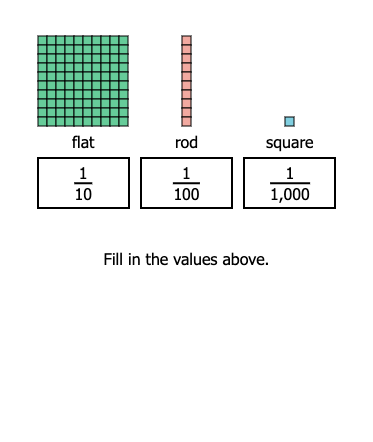
Model decimal fractions. If a flat is 1/10, what's a rod? 10 rods = 1 flat, so 1 rod = 1/10 flat and a rod is 1/10 x 1/10 = 1/100. A square? 10 squares = 1 rod, so 1 square = 1/10 rod and a square is 1/10 x 1/100 = 1/1,000. What's 2 flats, 3 rods, and 5 squares? The total value is (2 x 1/10) + (3 x 1/100) + (5 x 1,000) = 235/1,000. Prerequisites: 5-89 ○ 4-112, 4-46
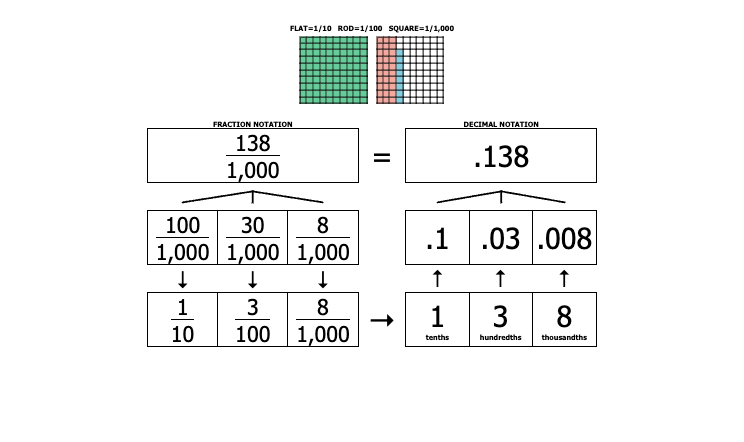
Use Base 10 notation to write decimal fractions - tenths, hundredths and thousandths. What's 138/1,000 written as a decimal number? 138/1,000 = 100/1,000 + 30/1,000 + 8/1,000 = 1/10 + 3/100 + 8/1,000, so write 1 in the tenths place, 3 in the hundredths places, and 8 in the thousandths place. 138/1,000 = .138 = 0.138. Prerequisites: 5-90 ○ 4-119
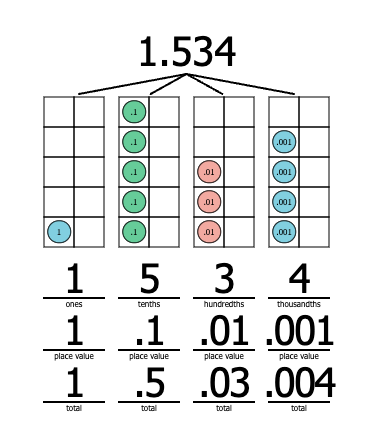
Use non-proportional, Base 10 discs to model expanded form. What's 1.534? Identify each digit's quantity and place value. Multiply to get its total value. 1.534 = (1 x 1)+(5 x .1)+(3 x .01)+(4 x .001) = 1 + .5 + .03 + .04. Transition from discs to number bonds. Emphasize the difference between a digit's quantity and value. Prerequisites: 5-91 ○ 4-117