Multiply decimals. Starty by using the partial products algorithm and the area model to multiply. Use fraction notation to keep track of quantities, units, and where to write the decimal point. Some may progress to using the standard algorithm.
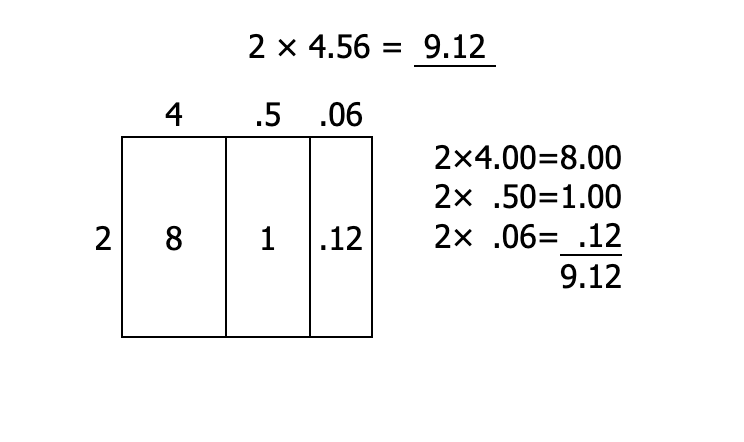
Use the area model to multiply by applying the distributive property. Find and add partial areas to get the total area. What's 2 x .06? Since 2 x 6/100 = 12/100, 2 x .06 = .12. What's 2 x .5? Since 2 x 5/10 = 10/10 = 1. Using fraction notation helps keep track of quantities, units, and where to write the decimal point. Prerequisites: 5-93 ○ 4-35
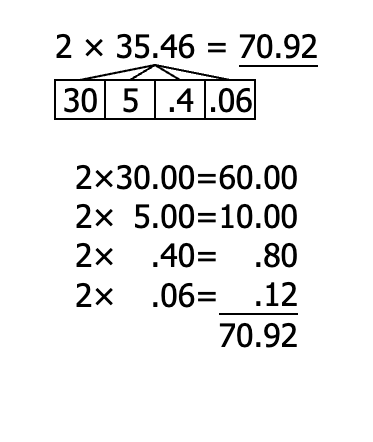
Use number bonds to multiply by applying the distributive property. Find and add partial products to get the total products. What's 2 x 35.46? Since 2 x 30 = 60, 2 x 5 = 10, 2 x .40 = .80, 2 x.06 = .12, and 60 + 10 + .80 + .12 = 70.92. Leverage understanding of fractions and the area model to multiply and make sense of decimals. Prerequisites: 5-104
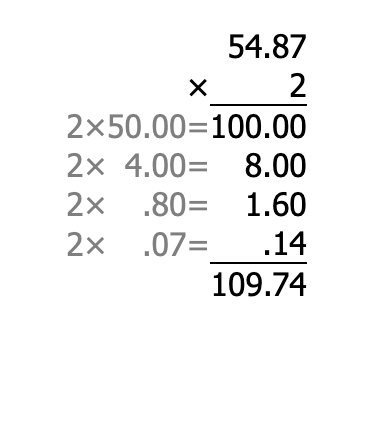
Multiply left-to-right, using the partial products algorithm. Keep track of place values by aligning the decimal points and emphasizing each digit's correct place value. What's 2 x .8? Since 2 x 8/10 = 16/10 = 1 6/10 = 1.6, write 6 in the tenths place and 1 in the ones place. Add partial products vertically to get the total product. Prerequisites: 5-105