Solve comparison problems that require both additive and multiplicative thinking -- at the same time. Use bar models to set up and keep track of work in 2-step word problems. Break a problem into manageable parts to decide the best order of steps to solve the problem.
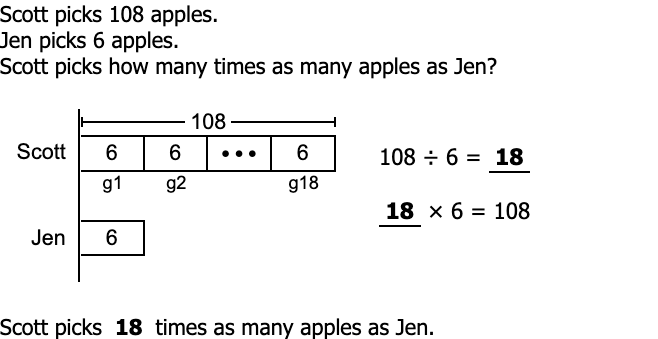
Assess understanding of multiplicative comparison by varying which is unknown – the scale factor, the larger number, or the smaller number. Multiply using partial products when the larger number is unknown. Divide using the grouping model and partial quotients when the scale factor or smaller number is unknown. Prerequisites: 4-19, 4-18 ○ 3-10, 3-9
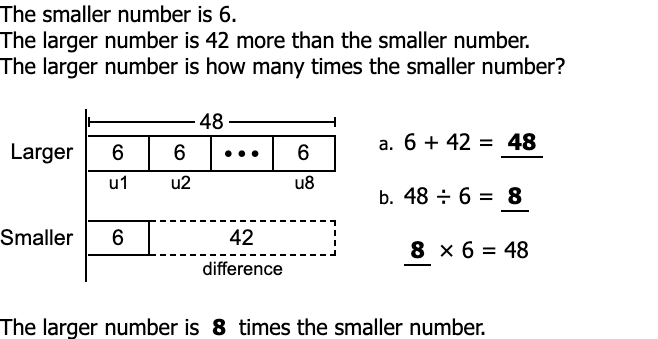
Use bar models to solve problems that compare numbers both additively and multiplicatively. If 6 is the smaller number and 42 is the difference, what's the larger number and scale factor? Since the larger number is 6+42 = 48, the scale factor is 48÷6 = 8. 48 is 42 more than 6. 42 is also 8 times as many as 6. Prerequisites: 4-20 ○ 4-18
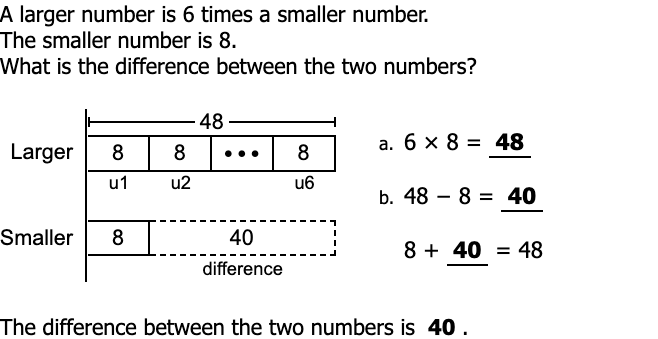
Transition to solving problems where the scale factor is known, but the difference is unknown. If the smaller number is 8 and the scale factor is 6, what's the larger number and the difference? Since the larger number is 6x8 = 48, the difference is 48-8 = 40. 48 is 6 times as many as 8. 48 is also 40 more than 8. Prerequisites: 4-20 ○ 3-7