Reason about remainders in different contexts. Solve word problems where the total, the group size or the group number is unknown, and report a remainder as a simplified fraction. Use the context of the problem to decide how to interpret the remainder. Can it be ignored or does it mean that the number of groups is 1 more than calculated?
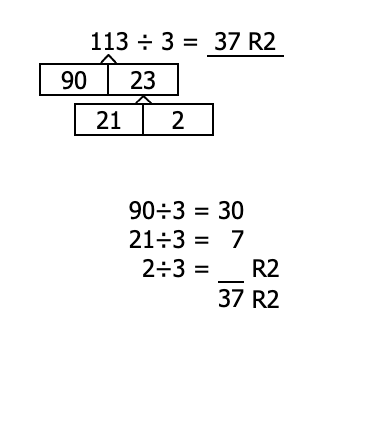
Transition from number bonds to the vertical, partial quotients algorithm. Start by solving problems with both models, side-by-side. Use the distributive property to break totals into parts, then add partial quotients to get the total quotient. When a part is less than the divisor so can't be broken apart further, label it the remainder. Prerequisites: 4-50
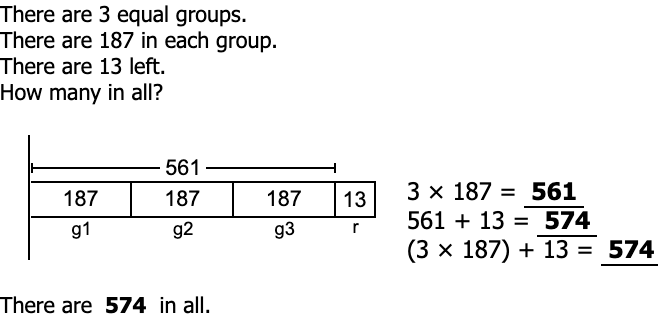
Interpret the remainder when the total is unknown. If there are 3 groups with 187 in each group, plus 13 more, how many in all? Multiply 3x187 = 561. Add 13 to get a total of 561+13 = 574. To solve as a single equation, use parentheses to group numbers explicitly. Follow the correct order of operations to get (3x187)+13 = 574. Prerequisites: 4-68 ○ 4-55
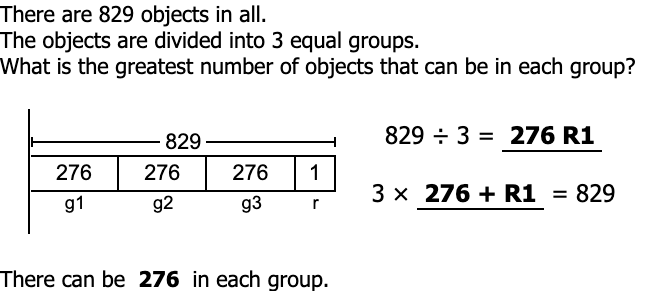
Interpret the remainder when dividing to find the size of each group. If 829 is divided into 3 equal groups, what's the most that can be in each group? 829 = 600+210+18+1, so 829÷3 = (6 hundreds÷3) + (21 tens÷3) + (18 ones÷3) + (1 one÷3) = 276 R1. The most that can be in each group is 276, so the remainder is ignored. Prerequisites: 4-69