Use linear and area models to make sense of multiplication in cases where both factors are fractions. Begin by multiplying a unit fraction by a unit fraction to find a new unit fraction, and progress to multiplying a proper fraction by a proper fraction.
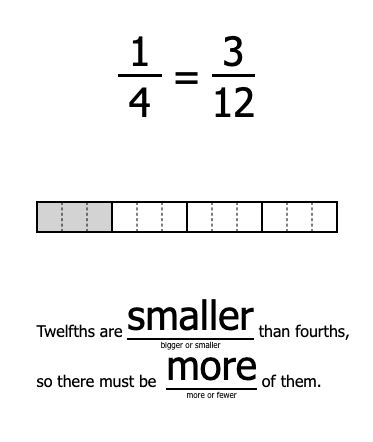
Use number lines to find equivalent fractions. 1 fourth is how many twelfths? Partition the distance from 0 to 1 into fourths. Make 12 twelfths by dividing each fourth into 3 equal parts. 1 fourth is 3 times 1 twelfth, so 1/4 = 3/12. Shortcut? Multiply numerator and denominator by 3. Get 3 times as many pieces that are 1/3 the size. Prerequisites: 3-84
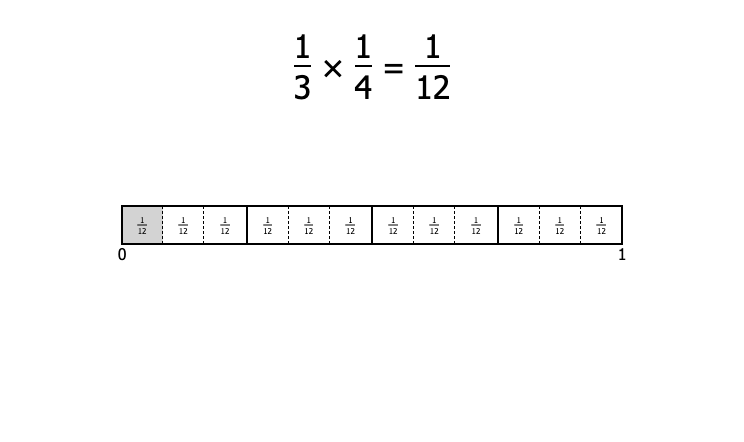
Multiply unit fractions to find a new unit fraction. What's 1/3 x 1/4? Draw 1/4 using a bar model on a number line. Divide 1/4 into 3 equal parts. What's 1 part? There are 12 parts in 1, so 1/3 x 1/4 = 1/12. Shortcut? Multiply the denominators. What's 1/2 x 1/5? 2x5 = 10, so the new denominator is 10, and the new unit fraction is 1/10. Prerequisites: 5-53 ○ 4-107
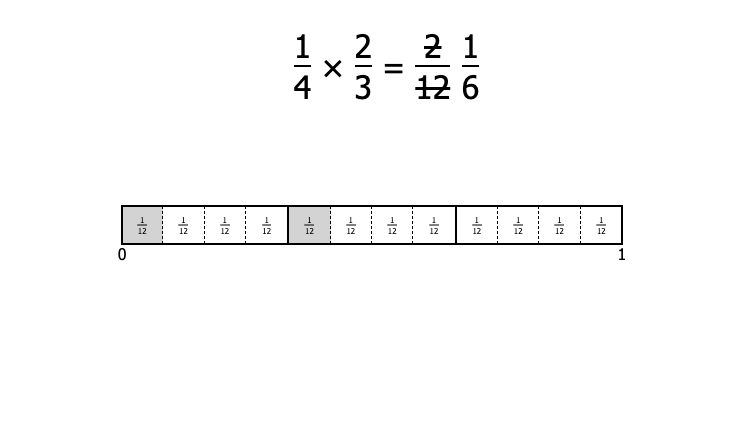
Multiply unit fractions and proper fractions by breaking proper fractions into unit fractions. What's 1/4 x 2/3? 2/3 = 1/3 + 1/3, so multiply 1/4 x (1/3 + 1/3) = 1/12 + 1/12 = 2/12 and 2/12 = 1/6. Algorithm? Multiply numerators to get the number of each part. Multiply denominators to get the size of each part. What's 3/4 x 1/2? (3x1)/(4x2) = 3/8. Prerequisites: 5-54