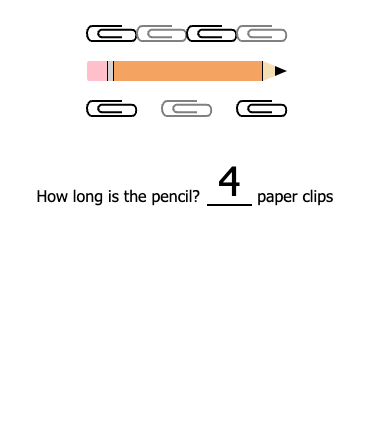
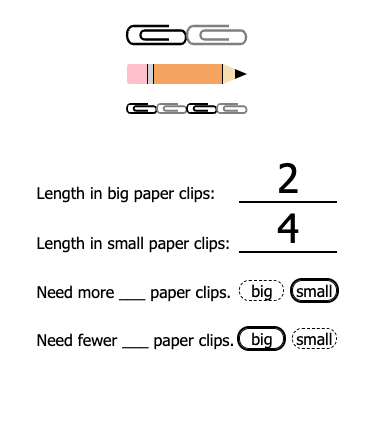
Address misconceptions about length. Use paper clips to model how gaps and overlap create inaccurate measurement, and the importance of measuring from the beginning of an object. Explore the relationship between the size and number of units -- we need more, smaller paper clips, and fewer, large paper clips.
Analyze measuring mistakes to deepen understanding about length. If the units have gaps between them, is the true length longer or shorter than the observed number of units? Longer. What if the units overlap? The true length is shorter. To measure correctly, the units must be aligned end-to-end with no gaps or overlaps. Prerequisites: 1-123
Explore the relationship between the size and number of units by measuring objects twice. Measure first with large paper clips, then measure with small paper clips. Which requires more paper clips? Need more, smaller paper clips, and fewer, large paper clips. There's an inverse relationship between the size and number of units. Prerequisites: 1-124 ○ 1-85
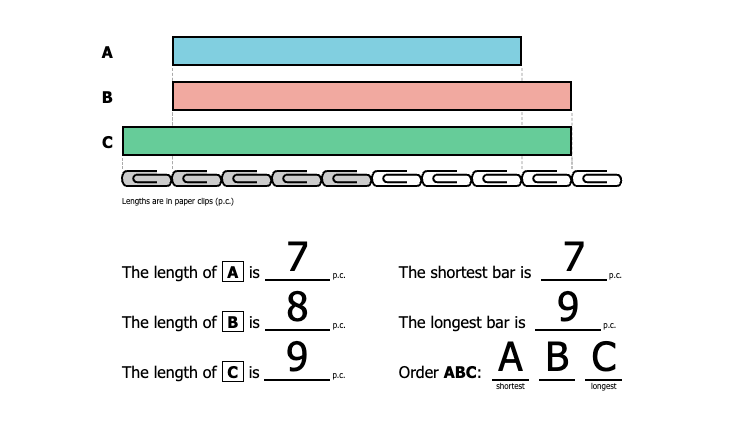
Measure length in non-standard units as the number of paper clips placed end-to-end with no gaps or overlaps. Reason, calculate, subitize, and compare to figure out how many without counting. To emphasize length as the distance between 2 points, measure from any paper clip instead of from the first paper clip. Prerequisites: 1-121