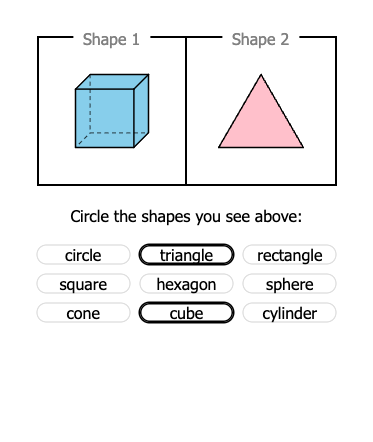
Compare the size, length, height, width, and area of circles and polygons, and identify shapes and solids by name. Use correct vocabulary to describe relative position of objects on a grid, to build spatial awareness, and to compare an objects' position relative to others.
Compare flat shapes or solids that may be rotated or scaled. Which defining attributes are the same? Which are different? If both are flat, how many straight sides do they each have? Are their sides all equal? How many corners or vertices do they have? If both are solids, how many faces do they each have? Prerequisites: K-123
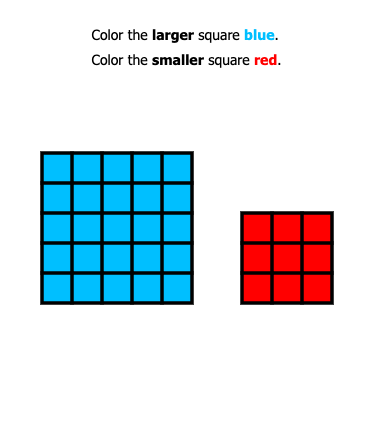
Lay the foundation for geometric measurement by comparing the size, length, height, and width of squares and rectangles. Use vocabulary including "larger," "longer," "taller," and "wider," as well as "smaller," "shorter," and "narrower." Does one shape fit inside the other? Use part-whole thinking when comparing. Prerequisites: K-73
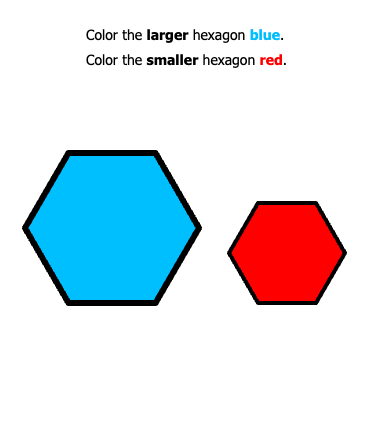
Generalize from comparing rectangles to comparing circles, triangles, squares, pentagons, and hexagons. Compare size and height by visualizing if one shape can fit inside the other. If it can, then that shape is smaller, shorter, and a part of the larger, taller shape. Build the conceptual foundation for part-whole thinking. Prerequisites: K-125 ○ K-7