Times Tables to 5
Introduce multiplication as equal groups, using bar models and arays. Systematically study 0-1, 2-3, 4, and 5 groups of 1-9. Break apart groups rather than skip-count, and use number bonds and equations to build fluency.
Get started with a free trial that includes 35 lessons per grade plus 25 tools, 10 videos and 4 puzzle packs. Contact us for school options.
Set up, organize, and manage your class easily. Create groups, assign lessons, and monitor real-time progress, all in one place.
Access lesson explanations, strategies and examples that align directly with Tang Math. It can even assist in differentiating instruction!
Complete 135-lesson scope and sequence for each grade K-5, pre-k program, summer school, and over 70 targeted intervention modules.
Identify gaps in foundational skills with our new game-changing diagnostics, which include source lessons, standards and a backfill plan.
Explore our simple, streamlined, and strategic intervention modules that cover all of the most important skills and standards at every grade.
Spiral review has never been easier, thanks to our automated workbook generator that allows seamless customization for your students.
Turn math anxiety into math automaticity with our digital, trackable, fluency problem packs that cover all four major operations.
Organized by strand and problem type in our tool bank, and built into each lesson, our tools develop deep comprehension and fluency.
Engagement like you've never seen! Make math practice accessible and fun and for learners of all ages, backgrounds and learning abilities.
Seasonal contests that turn routine review into high-energy, community-building, classroom events. Bring teamwork into math time.
Transforms rigorous practice into a compelling learning event. With just a few clicks, you can engage your students with targeted practice.
Tangy Tuesday and Wordy Wednesday puzzle packs give students a fun, focused way to build their fluency and problem-solving skills.
Greg Tang's best-selling books come alive in our interactive eBook library, with clever rhymes, colorful illustrations and clickable hints.
Interactive game boards, comprised of a multitude of math activities, are the perfect holiday or seasonal activity for your students.
Extensive library of recorded PD and student lessons that include read-aloud, model thinking, and guide users step-by-step.
Get the support you need through our live workshops or schedule PD for your team or faculty on the topic of your choice.
Fresh Thinking Foundation hosts a 2-day math conference this summer, to inspire, connect, and empower passionate educators like you.
Looking for the ultimate way to bring math fun to your families? Bring in Greg Jr. to your school for an unforgettable night of math mania!
Share ideas, thoughts, and questions with a community of teachers who are committed to transforming education for the world.
We're here to help! If you have questions, need support, or simply want to learn more about our program, don't hesitate to get in touch.
Introduce multiplication as equal groups, using bar models and arays. Systematically study 0-1, 2-3, 4, and 5 groups of 1-9. Break apart groups rather than skip-count, and use number bonds and equations to build fluency.
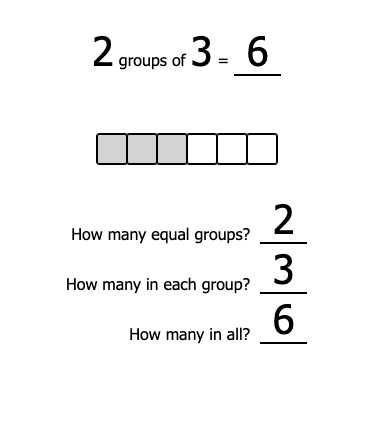
Use snap cubes to model equal groups. Represent values by the number and length of cubes snapped together. Focus on seeing, hearing, and understanding the difference between the number of groups and the number in each group – the size of each group. Add in smart ways to figure out how many in all – the total.
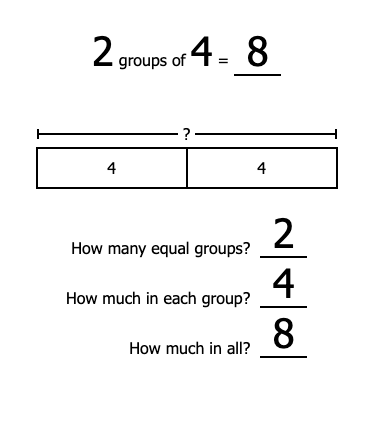
Use bar models to model equal groups. Represent values by the lengths of bars. To draw equal groups, draw a shorter bar and make copies. Alternatively, draw a longer bar and divide it into equal lengths. Draw halves to make 2 equal groups. Divide each half in half to make 4 equal groups. Visually estimate 3 and 5 equal groups.
Prerequisites: 2-17
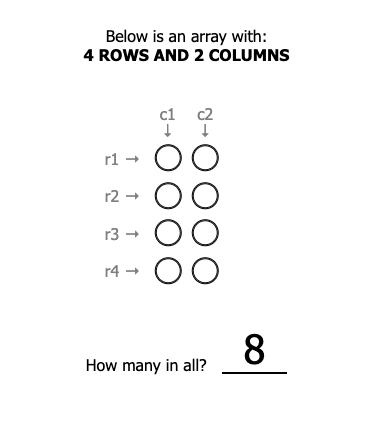
Color or draw an array with up to 5 rows and 5 columns of circles or dots. Use the convention that the number of rows represents the number of groups, and the number of columns represents the size or number in each group. An array with 4 rows and 2 columns is 4 groups of 2. Since 2+2+2+2 = 8, the array has 8 circles in all.
Prerequisites: 2-18