Connect division to related multiplication problems and differentiate between sharing and grouping contexts. The two give the same answer, but represent very different real-world models. This helps students solve word problems with deeper understanding.
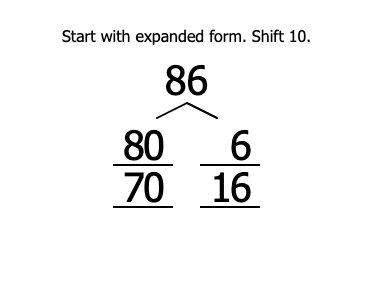
Transition from using concrete Base 10 Discs to using pictorial number bonds. What's 86? It's 80 and 6. Shift 10. The new number bond is 70 and 16. The Funny Number "seventy-sixteen" equals the real number "eighty-six." Start by shifting 10 in 2 steps. With practice, visualize and shift 10 in 1 step. Prerequisites: 1-102
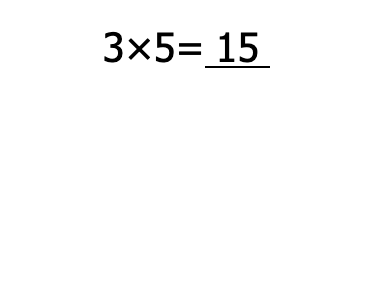
Transition from using number bonds to writing equations and using mental math. What's 3x5? Visualize 3 groups of 5 as 2 groups of 5 and 1 group of 5. Since 2x5 = 10 and 1x5 = 5, 3x5 = 10+5 = 15. Find and add partial products to get the total product – the distributive property. The goal is fluency first, then automaticity. Prerequisites: 3-32
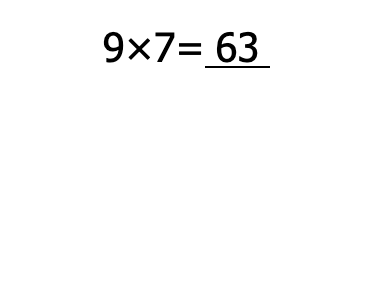
Transition from number bonds to using equations and mental math. What's 9x7? 9 groups are 5 groups and 4 groups. Since 5x7 = 35 and 4x7 = 28, 9x7 = 35+28 = 63. 9 groups are also 10 groups minus 1 group. Since 10x7 = 70, 9x7 = 70-7 = 63. Build computational fluency by breaking numbers apart in different ways. Prerequisites: 3-45