Identify which words describe a part and which describe the total. Use a part-total diagram to record, then calculate the missing value, in all of the different types of word problems. Start with learning problems, using numbers without a context, and progress to story problems that have a context to interpret.
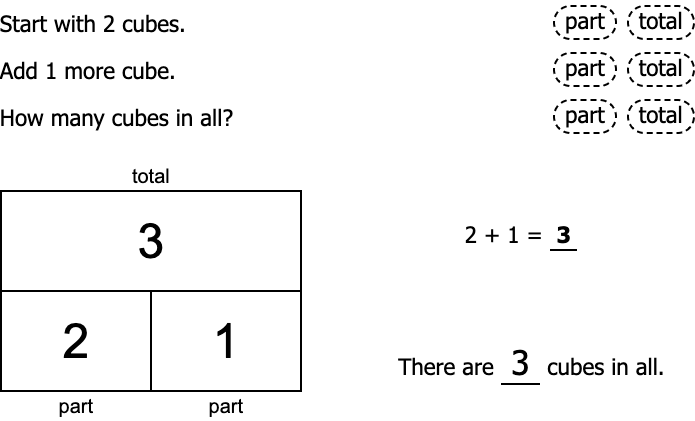
Start with learning problems – word problems that teach explicitly and don't require students to interpret context. Given the starting quantity and how much is added to it – find how many in all. Use a part-total diagram to visually show their relationship. Use snap cubes to model quantities and find the total. Prerequisites: K-31
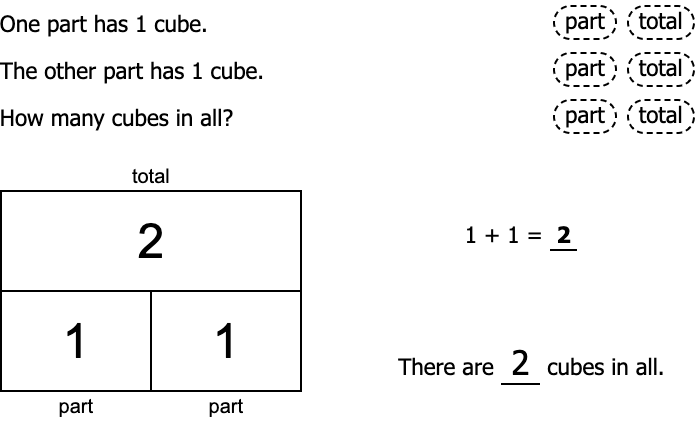
Model "Put-Together" problems. Instead of starting with one part and adding to it, start with two parts and join them together. If there is 1 cube in one part and 1 cube in the other part, how many cubes are there in all? Since 1+1=2, there are 2 cubes in all. Use a part-total model to visually show the relationship between the parts and total. Prerequisites: K-49
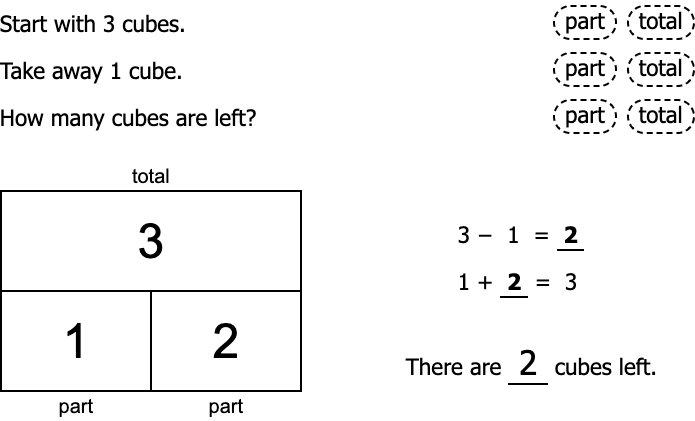
Model "Take-From" problems. Start with a total – the "start" – and take some away – the "change" – how much is left – the "result?" Use a part-part-total model to visually show the relationship between the parts and total. Use five frames and snap cubes if concrete manipulatives are needed. Prerequisites: K-43 ○ K-49