Use multiplicative reasoning to scale, or change, the size of the group -- by multiplying or dividing. Identify the number of groups, and the size of each group, in addition to the total value, and record notes with a bar model to see how they relate.
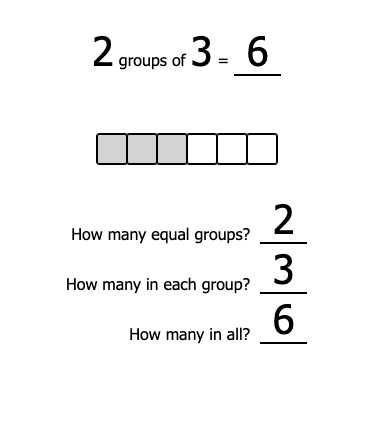
Use snap cubes to model equal groups. Represent values by the number and length of cubes snapped together. Focus on seeing, hearing, and understanding the difference between the number of groups and the number in each group – the size of each group. Add in smart ways to figure out how many in all – the total.
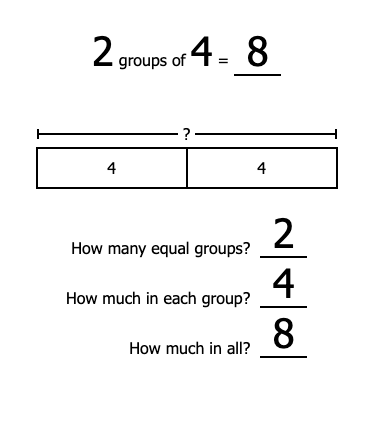
Use bar models to model equal groups. Represent values by the lengths of bars. To draw equal groups, draw a shorter bar and make copies. Alternatively, draw a longer bar and divide it into equal lengths. Draw halves to make 2 equal groups. Divide each half in half to make 4 equal groups. Visually estimate 3 and 5 equal groups. Prerequisites: 2-17
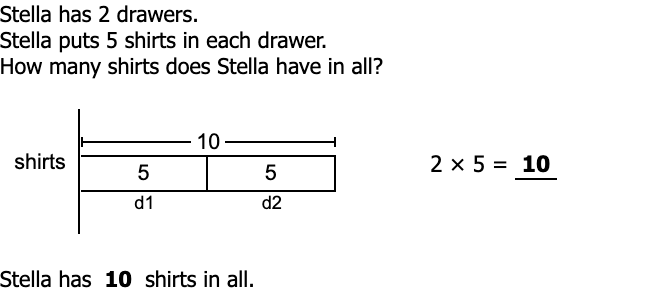
Use and interpret story problems to provide context for multiplication. Given the number of equal groups and the size of each group, find the product, or total. Use bar models to visualize the relationship between the parts and total. Apply the distributive property to find and add partial products to get the total product. Prerequisites: 3-33