Add and subtract fractions with like denominators - with and without regrouping. Make sense of fraction notation by understanding that the denominator is the unit, and only like units can be added or subtracted. (We cannot add 2 cats plus 3 dogs and get 5 cat-dogs, but we can add 2 animals plus 3 animals and get 5 animals.) Rename addends to have common denominators to add and subtract.
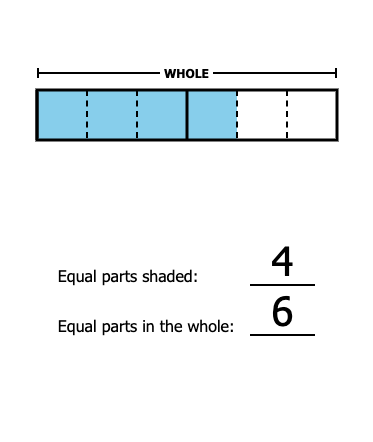
Divide bar models into halves, thirds, fourths, sixths, and eighths. Draw equal parts in smart ways. Divide halves into halves to make fourths, halves into thirds and thirds into halves to make sixths, and fourths into halves and halves into fourths to make eighths. Shade both contiguous and non-contiguous parts (gaps). Prerequisites: 2-56 ○ 2-53
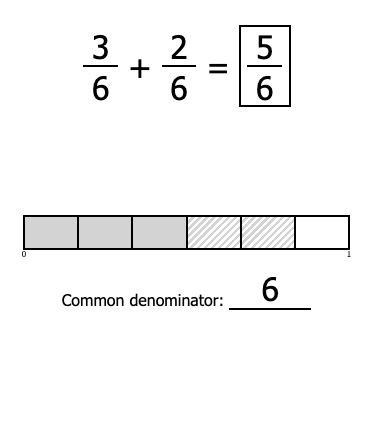
Generalize from whole numbers, to adding fractions with equal denominators. What's 3/6 + 2/6? To make sense of fraction notation, write units explicitly. 3 sixths + 2 sixths = 5 sixths, so 3/6 + 2/6 = 5/6, not 5/12. Develop modeling and drawing skills on a number line to lay the foundation for the other 3 operations. Prerequisites: 3-75
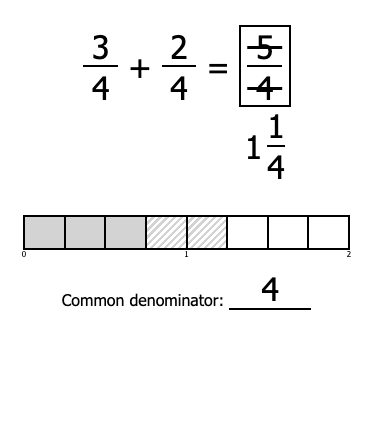
Transition to adding 2 fractions with equal denominators and sums greater than 1. What's 3/4 + 2/4? Their units are the same – they have common denominators – so add their quantities or numerators. 3 fourths + 2 fourths = 5 fourths, or 1 and 1 fourth. Using fraction notation, 3/4 + 2/4 = 5/4 = 4/4 + 1/4 = 1 1/4. Prerequisites: 4-98