Convert length, mass (weight), liquid volume, or time, from larger-sized units to an equivalent using smaller-sized units. Use bar models to represent the relationship between larger and smaller units of measurement, as an introduction to rates, ratios and proportions.
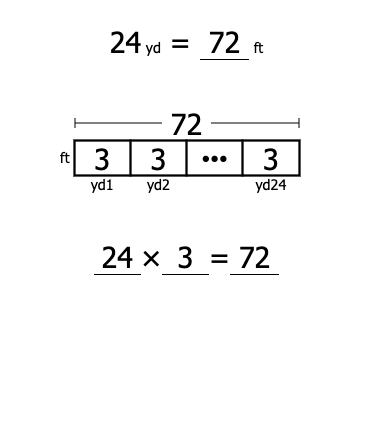
Draw bar models to visualize the relationship between larger and smaller units of length. 24 yards is how many feet? Start with the unit rate. Since 1 yd = 3 ft, 24 yd = 24 x 3 ft = 72 ft. Alternatively, 1 yd = 3 ft, so 4 yd = 12 ft, and 24 yd = 6 x 12 ft = 72 ft. Think proportionally and use partial products to multiply. Prerequisites: 4-10
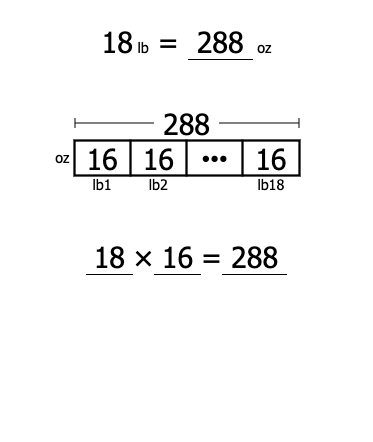
Generalize from converting units of length, to converting units of weight and mass. 18 pounds is how many ounces? Start with the unit rate. Since 1 lb = 16 oz, 18 lb = 18 x 16 oz = 288 oz. Alternatively, 1 lb = 16 oz, so 6 lb = 96 oz, and 18 lb = 3 x 96 oz = 288 oz. Think proportionally and use partial products to multiply. Prerequisites: 4-122
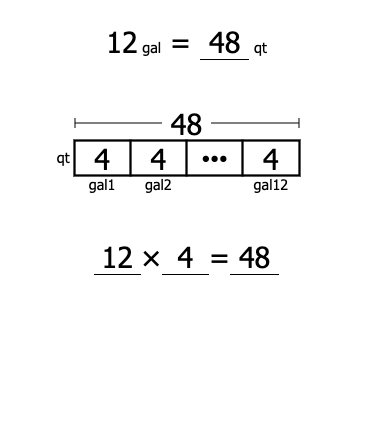
Use unit rates to convert measurements of liquid volume from larger units to smaller units. Convert gallons to quarts, quarts to pints, pints to cups, and cups to fluid ounces. With metric units, convert liters to milliliters. Multiply by thinking proportionally and using partial products. Work to commit unit rates to memory. Prerequisites: 4-123