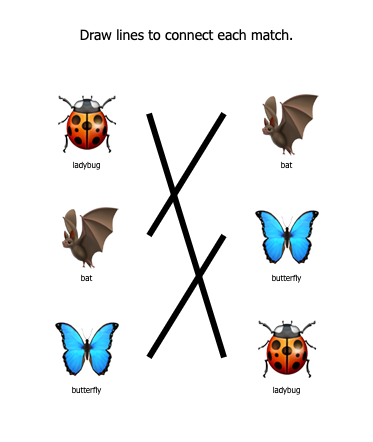
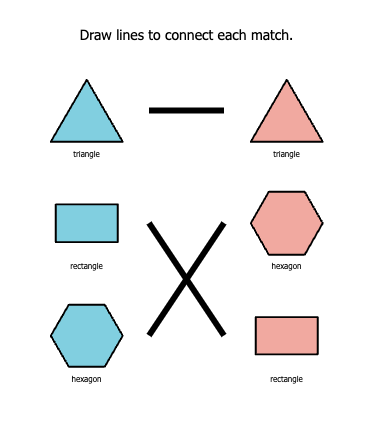
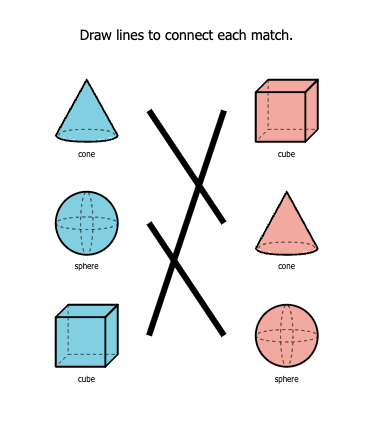
Match shapes, solids, and common objects. Practice part-whole thinking by breaking larger shapes into smaller shapes and joining smaller shapes to make larger shapes. Learn the difference between defining and non-defining attributes and explore what makes shapes the same or different.
Comparing is a key aspect of learning. Given 2 columns of pictures, match each picture on the left with the same picture on the right. Explore what makes 2 pictures the same and what makes other pictures different. Matching activities introduce the concept of 1-to-1 correspondence. They help prepare students for counting.
Introduce 2D shapes. Which shape on the left matches the same shape on the right? Matching sides and corners helps with one-to-one correspondence. Does a shape have an extra side or corner? Does it have more? If one shape has more, does the other shape have fewer? Match shapes to objects in the room. Prerequisites: K-1
Introduce 3D solids. When possible, use real solids as well as pictures of solids. Recognize and learn their geometric names by making connections to common and familiar objects. Which solid looks like a can of soup? Which solid looks like an ice cream cone? Which looks like an ice cube? A box? A ball? Prerequisites: K-2