Develop fluency with expanded form, shifting, and comparing 2-digit numbers. Using formal number names and nicknames, and a compare-the-parts strategy, along with expanded form, encourages base ten thinking. Shifting builds number sense and prepares for regrouping.
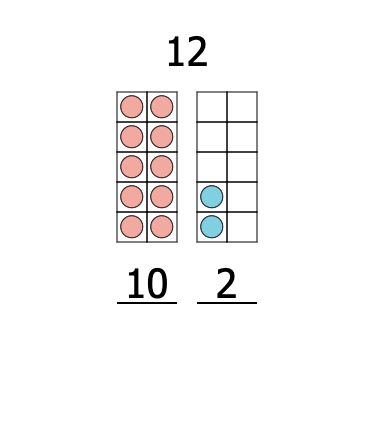
Lay the foundation for place value. Start by modeling teen numbers on ten frames. 12 is 10 counters and 2 counters – 10 ones and 2 ones – 12 ones in all. Transition to using Base 10 blocks or snap cubes to "unitize" 10 ones as 1 rod or unit. 12 is now 1 ten and 2 ones – 1 rod and 2 ones – not 12 cubes or counters. Prerequisites: K-110 ○ 1-31
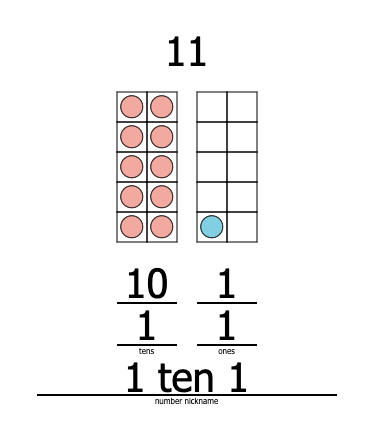
Since formal number names like "eleven," "twelve," and "twenty-six" do not emphasize tens and ones, use number nicknames that do. What's 11? It's 1 group of ten and 1 more, so its nickname is "1 ten 1." What's 26? It's 2 groups of ten and 6 more, so its nickname is "2 ten 6." Nicknames encourage Base 10 thinking. Prerequisites: 1-87
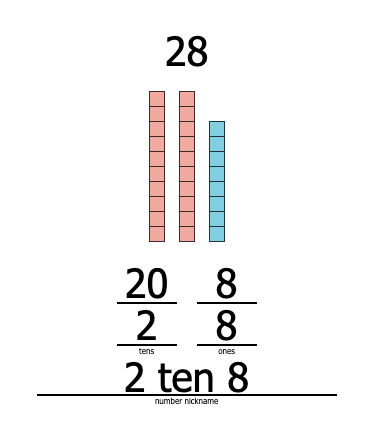
Transition from ten frames to using Base 10 blocks to unitize and model numbers in units of ten and one. What's 28? 20 and 8. It's also 2 tens and 8 ones. To know there are 8 ones, subitize the 2 that are missing. To encourage Base 10 thinking, use both formal names and nicknames. 28 is both "twenty-eight" and "2 ten 8." Prerequisites: 1-88