Apply the place value skills involving expanded form, shifting, and comparing, to larger numbers. Shift both 100 and 10, compare 3-digit numbers, model 4 and 5-digit numbers, and continue the place value pattern from 1 one 10 ones, 100 ones, to 1 thousand, 10 thousands and 100 thousands.
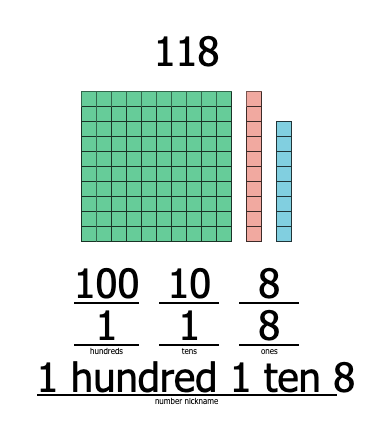
Progress from ten frames to more abstract Base 10 blocks. To start, use 10 rods to model 1 group of 100. What's 118? It's 100+10+8 = 1 hundred + 1 ten + 8 ones. When ready, transition to using 1 flat to model 1 group of 100. Notice that 10 rods "fit" on 1 flat. What's 104? It's 100+0+4 = 1 hundred + 0 tens + 4 ones. Prerequisites: 1-104 ○ 1-97
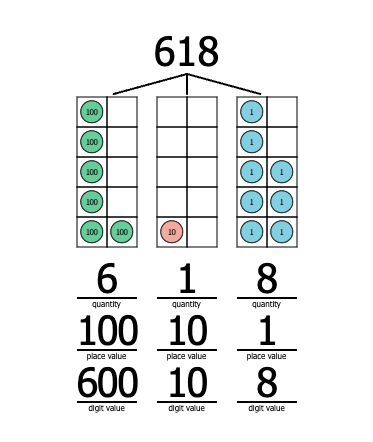
Encourage Base 10 thinking by decomposing numbers into expanded form. Use non-proportional Base 10 discs and ten frames to model quantities and place values concretely. What's 618? 6 hundreds, 1 ten, and 8 ones. Use "nicknames" to emphasize each digit's quantity and place value. "Six hundred, one ten, eight." Prerequisites: 1-106 ○ 1-105
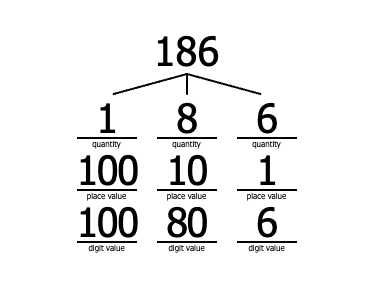
Transition from concrete Base 10 discs to pictorial number bonds. Break numbers into expanded form – hundreds, tens, and ones. Use "nicknames" to emphasize each digit's quantity and place value. What's 186? "One hundred, eight ten, six." 672? "Six hundred, seven ten, two." Write both nicknames and formal names. Prerequisites: 2-76