Use multiplication skills and patterns to identify multiples, common multiples and least common multiples. Determine divisibility, find factor pairs and identify prime and composite numbers using number bonds, partial quotients, and number lines.
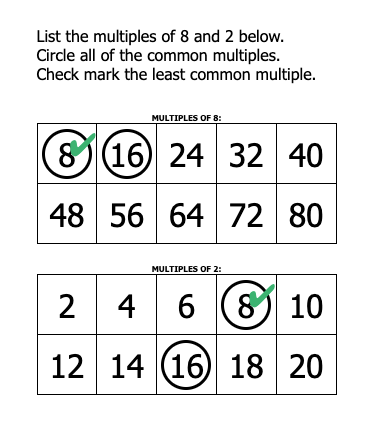
Find multiples, common multiples, and the least common multiple. List the first 10 multiples of 2 single-digit numbers. What are the multiples of 8 and 2? For 8, they are 1x8 = 8, 2x8 = 16, 3x8 = 24, etc. For 2, they are 1x2 = 2, 2x2 = 4, 3x2 = 6, etc. The common multiples are 8 and 16, so the least common multiple is 8. Prerequisites: 3-38
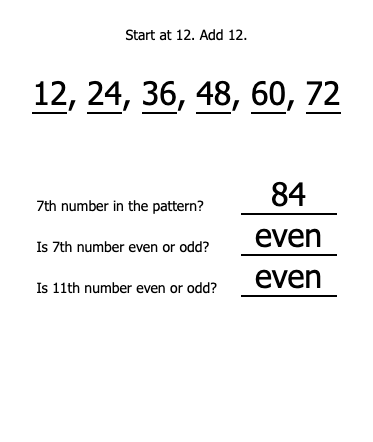
Use patterns to find multiples. Start with a rule and find the pattern. Start with a pattern and find the rule. If 12 is the first multiple and the rule is to add 12, what's the 7th multiple? It's 7x12 = 84. What's the 17th multiple? It's 17x12 = 204. Or, add 10 groups of 12 to the 7th multiple to get the 17th multiple. 84+120 = 204. Prerequisites: 4-59
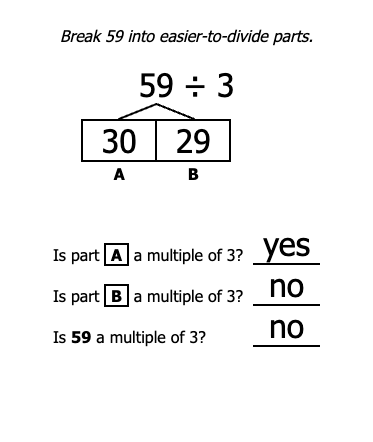
Use multiples to check for divisibility. Does 59 divide evenly by 3? 59 is divisible by 3 if it's a multiple of 3. To check, break 59 into 2 smaller parts. If both parts are multiples of 3, then 59 is a multiple of 3. Since 59 is 30 and 29, it is not a multiple of 3. 30 is a multiple of 3, but 29 is not. Check smaller parts instead of larger totals. Prerequisites: 4-60 ○ 4-14