Calculate perimeter and area of different shapes. Find the length of a side when area and one side of a rectangle is known. Use multiplication and division, rather than repeated addition and subtraction. Find the composite area of 2 contiguous rectangles by finding the partial areas and adding to find the total area.
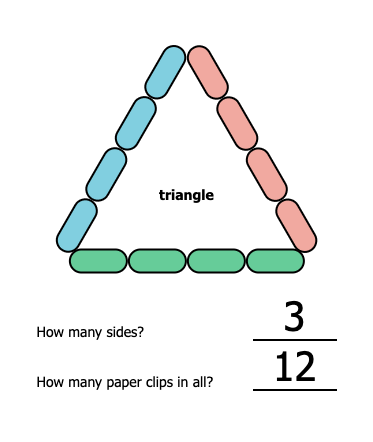
Use shapes to provide context for counting, skip counting, and adding, and also build a foundation for both multiplication and measurement. If each side of an equilateral triangle has length 4, what's the total length of all 3 sides? What's 4+4+4? Since 4+4 = 8 and 8+4 = 12, the total length of all 3 sides – 3 groups of 4 – is 12. Prerequisites: K-73 ○ K-72
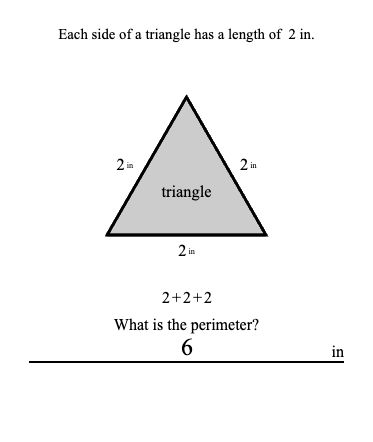
Provide context for multiplication by finding the perimeter of equilateral triangles, squares, and regular pentagons. If the sides of a triangle all measure 2 inches, what's the perimeter? Since the total length of all 3 sides is 3x2 = 2x2 + 1x2 = 6, the perimeter is 6 inches. Find and add partial lengths to get the total length. Prerequisites: 2-90
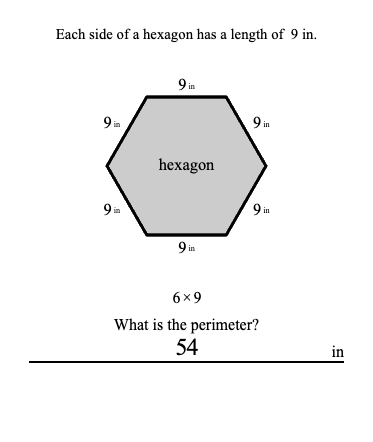
Reinforce multiplication facts by finding the perimeter of regular hexagons, heptagons, octagons, and nonagons. If a hexagon's sides all measure 9 inches, what's its perimeter? Since the total length of 6 sides is 6x9 = 3x9 + 3x9 = 27+27 = 54, the perimeter is 54 inches. Find and add partial lengths to get the total length. Prerequisites: 3-35