Explore strategies and algorithms for solving geometric measurement problems. Use a 2-dimensional area model rather than length-only bar models. Use multiplication and division to find area, perimeter and missing side lengths of rectangles, and solve multi-step word problems.
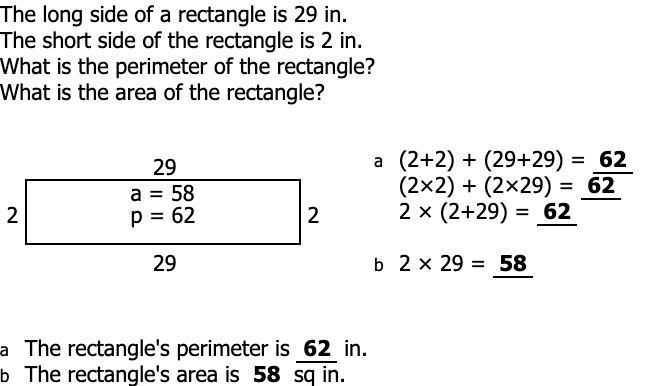
Use geometric measurement to provide context for multiplying. Explore strategies and algorithms for finding a rectangle's perimeter. Use a combination of addition and multiplication, and parentheses to group numbers and operations explicitly. For the same rectangle, calculate its area to differentiate it from perimeter. Prerequisites: 3-104 ○ 3-99, 3-35
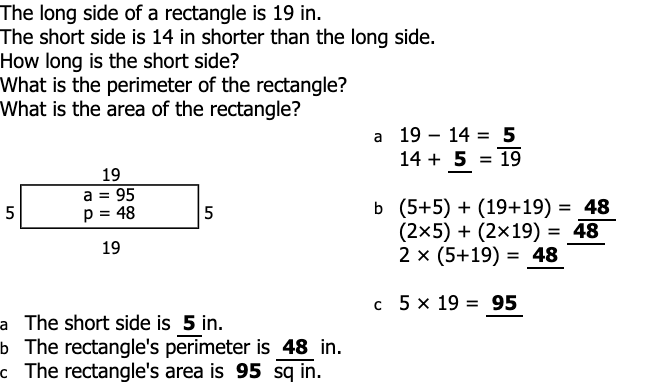
Progress to solving sequential, multistep problems. Given one side of a rectangle, find the length of the other side, the perimeter, and area. Emphasize more challenging, non-intuitive problems. If one side is 14 inches and it's 5 inches longer than the other side, how long is the other side? Would some answer 19 inches? Why? Prerequisites: 3-115
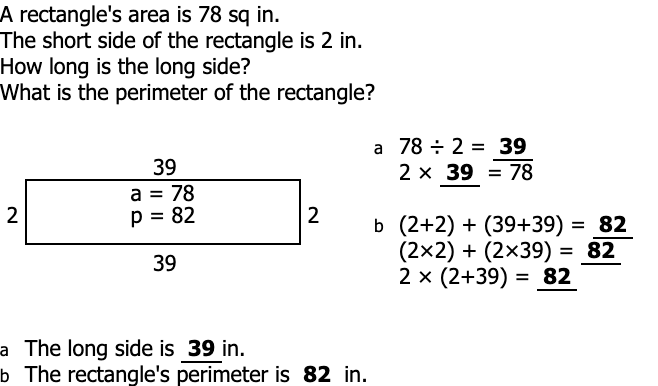
Generalize to problems using both multiplication and division. Given the area of a rectangle and length of one side, find the other side and the perimeter. Develop algebraic thinking by reasoning about the relationship between area, perimeter, and length. If 2 rectangles have equal areas, which will have a longer perimeter? Prerequisites: 3-116